Contents
Trauma, Resilience, and the Tantric Yoga Path
Getting stuck in traumatic situations means deep suffering. Trauma researcher Dr. Gabor Maté demonstrates in his work that almost every human being is confronted with childhood trauma—trauma that makes us ill as adults if we do not become aware of it and enter a process of resolution.
It is vital to recognize that our struggles with devotion and trust, with the joy of community, or the fear of love, are not private issues but societal ones. What does this mean?
From the outside, we seem to have everything under control: children are at school during the day, often followed by piano, painting, or sports lessons, or other institutions where they spend their afternoons. Mothers and fathers go to work, and in the evening, when they are finally with their children, they are tired and exhausted. Is all of this okay simply because it is now “normal”? Apparently not. This reality is hostile to children indeed, hostile to humans and it causes illness. Where is the time for aimless togetherness within the family? Where can children of different ages still gather in nature and explore the world together without supervision? Where am I still in direct contact with birth and death? Where do laughter, humor, and joy in one another create a sense of “home”?
Arno Gruen calls our reality the “Insanity of Normality,” where we view and accept conditions as normal that are destructive to us and our society. I remember the irritation I felt a few years ago when a friend said, “My son has to learn to adapt; he doesn’t function in school the way he should.” Today, I hear this often. We are not machines! What does it mean when we grow up in a seemingly secure society where children who are forced to “function” cannot feel safe? Where the pressure to perform becomes paralyzing, and the feeling of being isolated and “not enough” has become the “norm” for many? Where our youth are asked to adapt to a system at a historical moment when the ruling system only produces polycrises? Where the creative power of youth to change this inhuman culture has become vital for the survival of humanity? How can we support each other and become part of the solution?
In this context, what increasingly alienates me is the inflationary use of the word “trauma.” I find it problematic. In its original meaning, the word refers to a “situation of shorter or longer duration… of catastrophic proportions, which would cause deep despair in almost anyone, e.g., natural disasters, war… or being a victim of torture, rape, abuse, or other crimes” (ICD-10 medical classification system). This definition describes situations in which a human being is completely and totally at the mercy of others as a victim.
It is true: the process of socialization from baby to adult also involves violations of my integrity. Every human being undergoes this process. We are all educated. That hurts. However, if I label negative childhood experiences which, unlike trauma in the original sense, were not extremely incisive as “trauma,” I am tempted to give up my personal power as an adult.
What do I mean by that?
I observe in our courses that the topic of childhood trauma appears more and more frequently. It is often used to excuse weaknesses without taking responsibility for oneself and one’s own life. Many see themselves as victims and get stuck in self-pity. The word “trauma” suggests the helpless victim. To me, this is a trap.
A Situation During Our Yoga Teacher Training: Klara’s Decision
Klara is sitting in the common room. She is talking so loudly that everyone is forced to overhear: “You shouldn’t have touched me on the shoulder without asking. Now I can’t feel myself for the rest of the day. I have Post-Traumatic Stress Disorder. People have to be careful with me.” She mastered the technical vocabulary to explain her childhood traumas: “I’ve had four years of psychological treatment—and nothing helped.” After only three days, she had established a clear perpetrator-victim structure within the group. No one was allowed to criticize her—that would make her ill. When we, the teachers, pointed out that in a training program, it is not possible to “cut class” or leave the room without comment, we were told we weren’t “trauma-sensitive.” At the same time, I could see she was a person of high energy who identified with being a victim and had learned to exercise power through it.
We met to talk with Klara. We had to tell her she must leave the school: “We are not a psychosomatic clinic, but a space centered on self-responsibility and self-empowerment. That is the prerequisite for becoming a yoga teacher. The Tantric Yoga path is the path of the Spiritual Warrior. We support people who consciously step out of the victim role. It is about changing oneself, not identifying others as perpetrators as soon as they do not dedicate themselves to my personal well-being.”
Suddenly she became quiet and cried. She said she had learned more in those four days than in four years of therapy. That she had rediscovered her “dance.” Yes, she said, she understood us now—and yes, she wanted to step out of victimhood. To attend all classes. And to write and sign a text stating that she could and would do so.
In that moment, Klara was completely present and vulnerable in a strong way. We decided: “You can stay.” In the period that followed, Klara was like a different person. She deepened her creative, “wild-gentle” dance. She became compassionate toward others. Friendly. She could ask for a hug… and endure it if the answer was no. She immersed herself in the group process and learned to stay with herself simultaneously. And in the final exam, it showed: her yoga teaching was truly excellent.
The Wisdom of Trauma
If trauma psychologists are to be believed, more and more children and young people are falling into the “trauma trap” in a society where performance and competition are paramount and adults are often under permanent stress. Children become lonely. And more and more adults perceive blockages within themselves that impair their joy of life. But Gabor Maté’s film is not called “The Wisdom of Trauma” for nothing. If I deal with my injuries with solidarity, I can heal them. I understand that upbringing creates trauma, that I am
shaped
as a human being, yes, that this belongs to the nature of being human. But only I, as a human, have the possibility to perceive and dissolve these blockages. For us, it is not about what happened, we cannot change that. It is about: how do I react to this past event and how do I interpret it? How do I integrate it into my self-image? How can I live the wisdom of trauma?
Ordinary Magic
Resilience research aims to show how people manage to build an inner stability to overcome trauma. Resilience comes from the Latin word resilire: to bounce back, not to cling. A person with the capacity for resilience manages to let traumatic experiences bounce off rather than stick. Professor Ann Masten describes resilience as “ordinary magic” and says: “We are reprogrammable to an extent that the pioneers of resilience could not have imagined. We are dynamic systems; we can change.” This sounds exciting and rebellious. We do not have to remain victims of our traumas and imprints! We can program ourselves, or better yet: reinvent ourselves every moment!
The techniques scientists have discovered for building resilience have much in common with the Tantric Yoga path and other “paths of the heart” like Buddhism, Sufism, or Shamanism. It is always good to realize that ancient spiritual knowledge is increasingly being confirmed by science. However, the spiritual approach to building resilience is often left unmentioned: I connect with a power greater than myself, “The Great Mystery.” I can ask for support for my healing path. Prayer “works.” Through my spiritual practice, I can experience that my life has meaning. Now it is about the power of my decision not to allow the traumatic event to destroy my life. I cannot change the past, only my “now” and the future.
I seek information to build a positive mental field within myself. I practice relaxation techniques like Yoga Nidra, meditation, or a meditative asana practice; I consciously enter into a community with people who empower me; I take care of my friendships. I know the value of a stable partnership and understand that love is not synonymous with “romance.” Added to this is the conscious perception of the body, enough movement, and sleep. I learn to focus on the solution, not the problem with a good dose of humor. I understand that life is a process. I open myself to a change in perspective and allow myself to recognize opportunities even in crises. It is about enduring uncertainty and understanding that change is part of life.
Healing
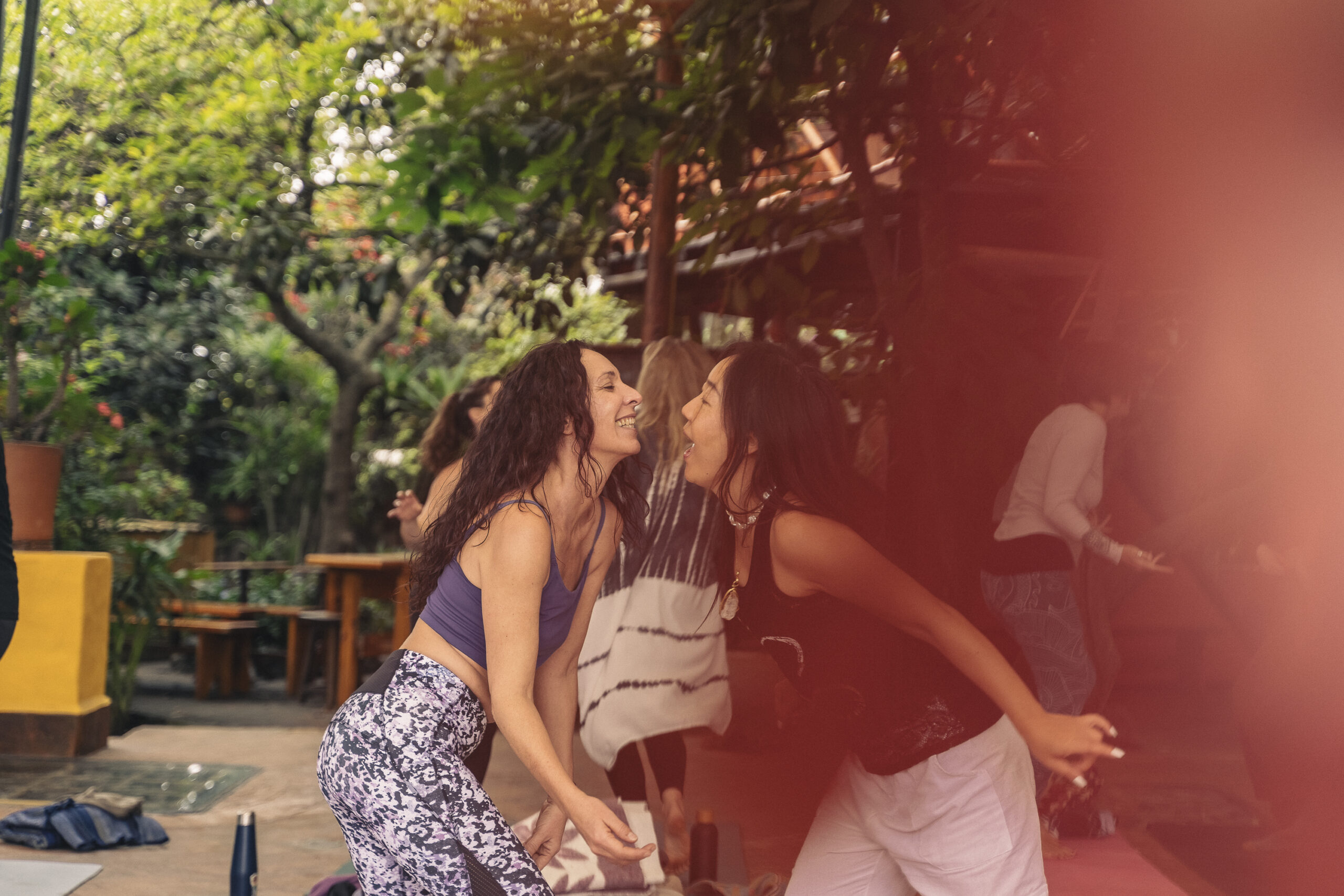
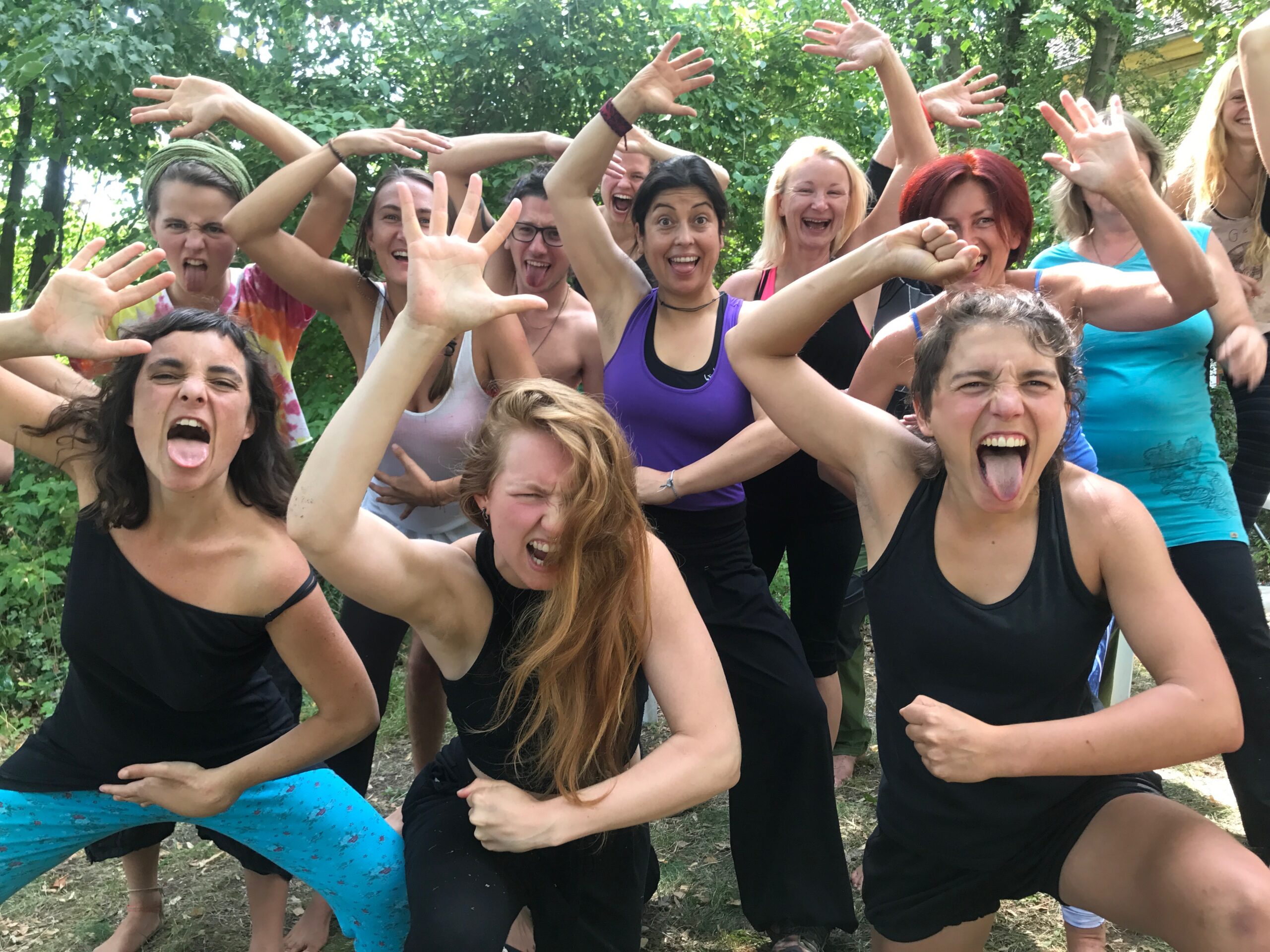
In our experience, much healing is moved through a retreat structure: in our Tantric Yoga Ashram, we live together. Every day, we collectively move bodily and psychological energy in classes lasting eight to ten hours, where we listen inward and then become creative. We are witnesses to healing processes. We embrace the crisis when blockages appear. When we celebrate rituals together, laugh, and communicate from the heart. Because in such high-energy, magical moments, I realize: I don’t have to jump over blockages, they simply fall away. I gain confidence in my personal power to shape my world. I then refuse to “function” and allow myself to live in a way where body, mind, and soul are allowed to dance together.